Project
VAMOS+: A COMMUNITY PLATFORM FOR PADEL
A padel-first platform bringing players, coaches, clubs, and suppliers onto one system, with free tools …
Seven open-source Django packages on PyPI plus a private catalogue, each its own repository with independent CI and release cycle, so projects adopt infrastructure instead of rebuilding it.
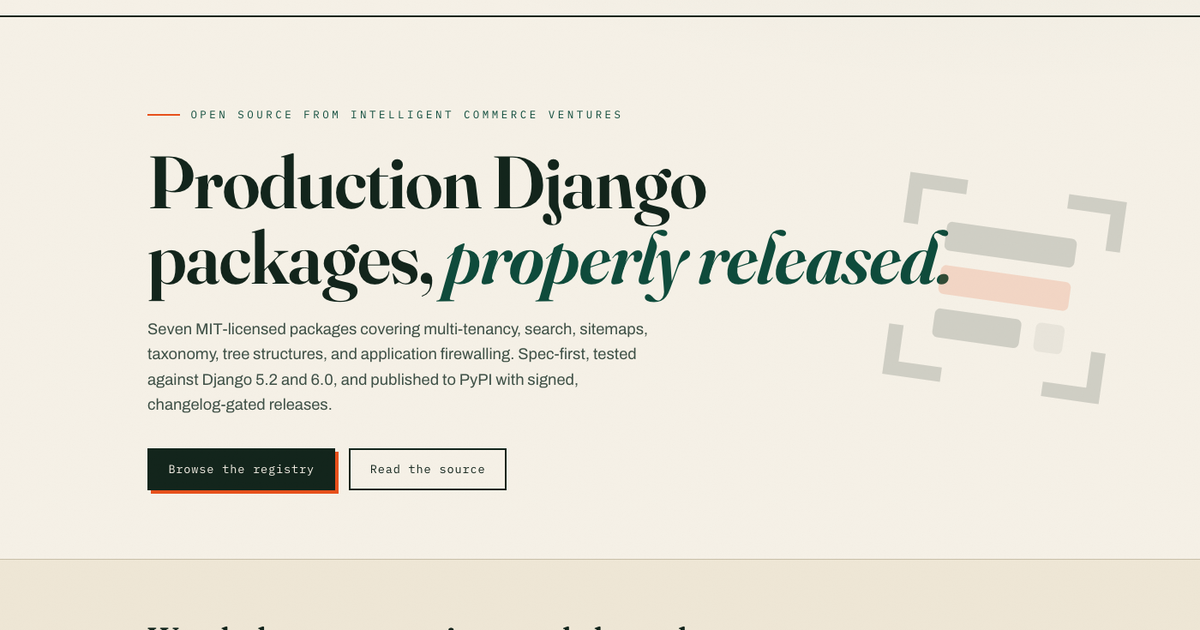
ICV OSS is a family of reusable Django packages I build and maintain. Every package is a standalone git repository with its own GitHub remote, CI pipeline, and release cycle, grouped under a single documentation umbrella. Seven packages are open source and published on PyPI; a further catalogue of packages is developed privately and graduates to public when a real consuming project needs it.
The point is simple: consuming projects should adopt a package rather than reinvent one. Multi-tenancy, search, tree structures, taxonomy, sitemaps, a web application firewall: these are solved once, versioned properly, and reused everywhere.
Across every Django project I run, the same infrastructure kept getting rebuilt from scratch: row-level tenancy, full-text search, materialised-path trees, SEO discovery files, bot protection. Each rebuild was a little different, a little worse, and impossible to fix in one place.
Factoring these into independently-released packages means a fix or an improvement lands once and every project picks it up on its next dependency bump.
The umbrella repository tracks only shared documentation and templates. Each package lives in its own repository so it can be versioned, tested, and released on its own cadence.
The ecosystem follows a deliberately flat dependency topology: cross-package dependencies resolve only through PyPI, never through sibling paths, and django-icv-core is never a hard dependency (packages integrate with it behind an optional extra with guarded fallbacks). Releases are tag-push driven, publishing to PyPI through OIDC trusted publishing, and CI refuses to publish without a matching changelog entry.
Private packages are served from a self-hosted index and promoted to the public track only on real demand, so the public surface stays small and genuinely reusable.
A padel-first platform bringing players, coaches, clubs, and suppliers onto one system, with free tools …
A multi-tenant CMS and commerce platform using PostgreSQL schema-based isolation, with a headless content API …
Website and client platform for a premium advanced skin therapy studio in Lanzarote: a bilingual …
£900/day · Available for projects · Usually responds within 24 hours